Volume IV · Buying property
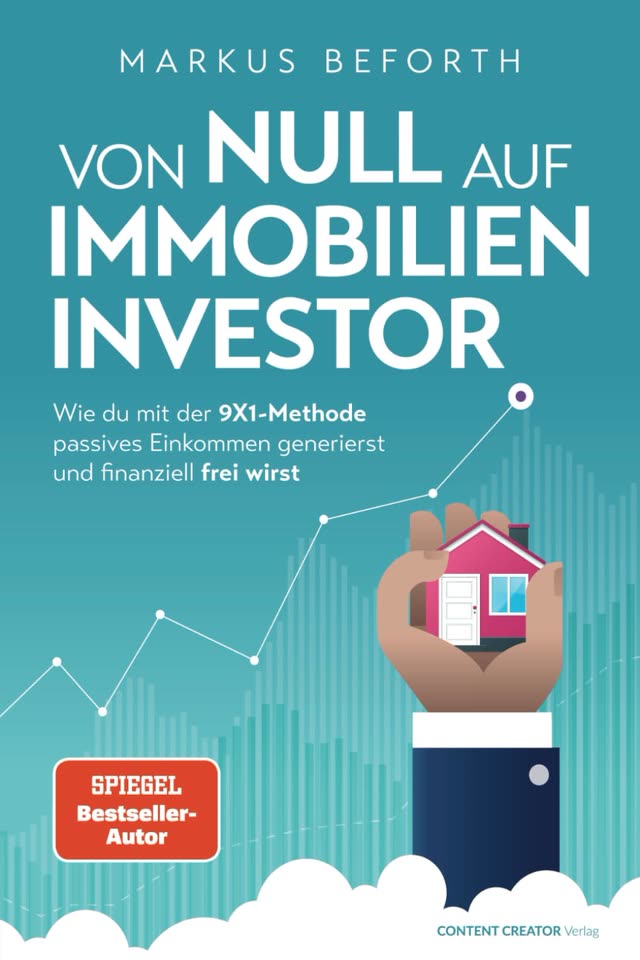
Von null auf Immobilien-Investor
In Von null auf Immobilien-Investor, Markus Beforth explains how to approach a property purchase systematically, from preparation to the final decision. The focus is on knowing what you want, preparing financing early and working effectively with banks, estate agents and sellers. His advice on being ready to act sooner, making a positive impression and preparing for negotiations is particularly practical. His central message is that preparation, commitment and good relationships considerably improve your chances of securing a suitable property.
Learnings
- Build your speed advantage before the opportunity appears. Beforth recommends having your financing assessed using a representative property that matches your plans as closely as possible, and explicitly requesting written confirmation of financing. When the right listing comes along, your bank contact, paperwork and budget are already prepared. The specific property still needs to be assessed separately afterwards.
- Practise important conversations beforehand. His exercise is to list ten different banks and start with your least preferred one. That gives you a chance to improve your paperwork and presentation before the most important meetings. Bring a realistic statement of assets, a complete household budget and, for an investment property, a clear calculation that others can follow.
- Prepare a good enquiry and respond quickly. His email to an estate agent has four elements: a personal greeting, a specific intention to buy, evidence that you can afford the purchase and a short explanation of your personal motivation. Adapt the template each time and, where possible, send it on the same day a suitable listing appears. For me, there is a clear efficiency lesson here: recurring communication can be prepared in advance.
- Follow up on less obvious opportunities, too. Beforth would not immediately rule out agents who fail to reply. Instead, he recommends checking their websites weekly. He also sees poor photos and brief listings as possible opportunities because they can put other buyers off. Presentation alone says little about the quality of an opportunity.
- Show appreciation through concrete actions. Being punctual, giving the other person your full attention when greeting them, offering a specific compliment or bringing a cappuccino are ways to leave a positive impression. Beforth even recommends leaving a five-star review before the viewing. My main takeaway is to give the other person deliberate attention; the early review is his particularly tactical version of that idea.
- Use three questions to uncover the information that matters. What is missing from the listing? Why is the owner selling, and what matters to them? What needs to happen for the purchase to go ahead? With these questions, Beforth clarifies additional risks, the seller's interests and the next step. The final question in particular turns a non-committal conversation into a concrete process.
- Bring an offer to the viewing. His tip is to prepare a personal offer letter with written confirmation of financing attached. Leave the price blank at first and fill it in by hand at the viewing. This gives the agent something they can pass straight on to the seller. The prerequisite is that I have worked out my price range beforehand.
- Use the viewing with a clear purpose. Beforth sees the first appointment as a comparison between the listing and reality: do the layout, condition, fittings and orientation match? Note any discrepancies calmly. He places the detailed technical inspection after a provisional agreement and before the final contract is signed. What matters to me is knowing which questions need answering at each stage.
- Explore room for negotiation with hypothetical questions first. Beforth uses phrases such as: “Suppose I offered … — would we have a deal?” This lets you gauge a response before making a final offer. He justifies lower prices with specific discrepancies. He recommends practising these conversations with a friend or partner beforehand.
- Know the price you are comfortable with and stand by it. Before negotiating, I should know what amount I am prepared to accept and how I will respond to a rejection. Beforth suggests mentally adjusting the price in €1,000 increments together with everyone involved until it feels right. He also emphasises the value to the seller of secure financing, reliability and a quick transaction.
- Understand the key documents yourself. He particularly highlights the living-area calculation, the declaration dividing the property into individually owned units, reserves, special assessments and the minutes of the last three owners' meetings. If the agent cannot obtain documents, Beforth recommends getting appropriate authorisation to make your own enquiries with the property management company and building authority. Personal conversations and, where needed, an expert should complete the picture.
- Explain your decision to decline and keep contacts alive. If you decide against a property, explain your reasons clearly and politely, and express your thanks. If another buyer gets it, Beforth asks about the progress of the sale roughly once a week and enquires about new properties along the way. If he knows the date of the notary appointment, he makes a note to follow up afterwards and, where appropriate, offer congratulations. This keeps him in mind as a possible backup buyer and for future opportunities.
- Be willing to walk away despite all the preparation. Lack of financing, an unmet non-negotiable criterion, an unsuitable price or persistent unease can all be reasons not to buy. Time already invested does not oblige me to continue. For me, making a good decision also means being able to deliberately let an opportunity pass.