Volume III · Buying property
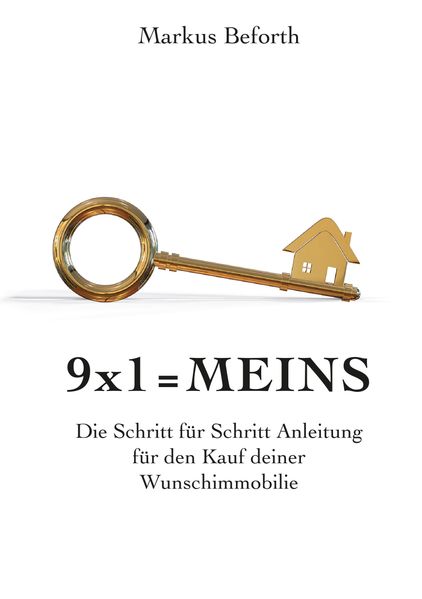
9x1 = Meins
“9x1 = Meins” by Markus Beforth is a practical guide for people who want to buy a residential property to live in or as an investment. Instead of starting straight with the property search, the book shows how important systematic preparation is and breaks the whole buying process down into nine steps that build on each other. It focuses in particular on knowing your own requirements and financial limits, approaching banks and estate agents well prepared, and acting reliably and professionally throughout the purchase. The central idea: you find and secure the right property less through luck than through preparation, clear decisions and a structured process.
Learnings
- The real work starts before the property search. First decide who you are buying for, what and where. I find the distinction between genuine deal-breakers and points where I am willing to compromise especially helpful. That way you judge offers against criteria set in advance rather than by spontaneous enthusiasm.
- “Affordable” and “financeable” are two different questions. Just because a bank would finance a certain purchase price for me doesn't mean I want to, or should, spend that amount. Beyond the mathematical viability, I should therefore decide beforehand what level of debt, monthly burden and long-term commitment I am actually comfortable with.
- Don't sort out the financing only once the perfect property has turned up. The author recommends arranging a reliable assessment or financing confirmation before serious viewings. The practical idea behind it convinces me: when a good property comes up, my ability to decide shouldn't depend on a bank only then starting a review that takes several weeks.
- You have to actually know your own financial situation. A statement of assets and a household budget aren't just paperwork for the bank but a form of self-check. The book's simple reality check makes particular sense: if the calculated annual surplus doesn't roughly match the actual growth in wealth, expenses are probably missing from the calculation.
- With investment properties, the spreadsheet mustn't be the only decision criterion. Accessibility, management effort, time, possible problems with the property and my own relationship with the location belong in the calculation just as much as yield and financing. As the book argues, property is precisely not a fully passive investment.
- In the competition for properties, the purchase price isn't all that counts. Sellers and agents also judge how reliable, decisive and uncomplicated a prospective buyer appears. A clear intention to buy, financing in place, quick communication and a professional manner can therefore give a real advantage over buyers who may offer a similar amount but seem uncertain.
- Don't see estate agents merely as a necessary obstacle. For me, one of the book's strongest shifts in perspective is to keep the interests of the other parties in mind. An agent wants a deal that is as safe as possible with as little extra effort as possible. If you understand what the other side needs, you can shape communication and process accordingly, without automatically treating every situation as a contest.
- Speed only works if clarity has been created beforehand. When criteria, financing and price limits are settled, I can react quickly to a suitable offer without acting rashly. For me, this is one of the most transferable points of the book: good preparation shortens later decisions considerably.
- Viewing, purchase decision and technical inspection are separate tasks. The book recommends using the first viewing mainly to check whether reality and the listing broadly match, with a detailed review of documents and building fabric following afterwards. What matters is that this thorough review is actually completed before the notarised, binding purchase, bringing in experts where needed.
- Your own upper limit has to be fixed before negotiating. I find the idea of the “comfort price” particularly relevant: don't decide in the middle of an emotional conversation how much further you would go, but beforehand. New information can change an offer, but the change should have a factual reason and stay within a limit defined in advance.
- A bad feeling shouldn't simply be ignored just because the numbers add up. The book gives surprisingly much room to combining rational analysis with gut feeling. For me this doesn't mean making decisions irrationally, but treating a lasting unease as a signal to take a closer look once more.
- A rejection isn't automatically wasted work. Even if a particular property isn't bought, the market knowledge, sharper criteria, experience with financing and negotiation, and contacts remain. That makes the next round faster and more precise.
- The overarching learning goes beyond property: clarity, preparation and commitment reduce chance. At the same time, the author thinks strongly in terms of long-term relationships and win-win situations rather than only the maximum advantage of a single deal. I find this basic idea far more valuable and universal than some of the very tactical sales techniques in the book.
Links marked with * are Amazon affiliate links. If you buy a book through one, I earn a small commission. It costs you nothing extra.